


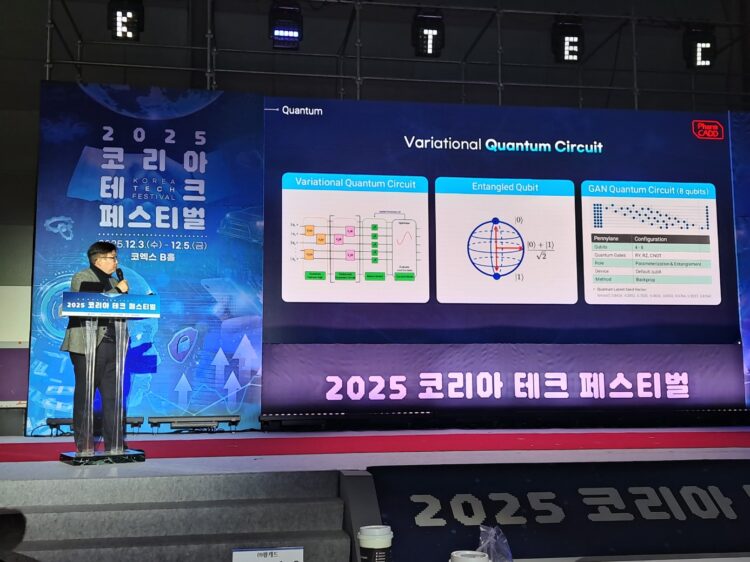
On the 5th of last week, at the “2025 Korea Tech Festival” held at COEX in Seoul, one session in particular drew strong attention from pharmaceutical and biotech industry professionals. The “Quantum Technology Use-Case Demonstration Event,” hosted by the Ministry of Trade, Industry and Energy (MOTIE), highlighted real-world applications of quantum technology.
Taking the stage, Sangwook Wu, CEO of AI drug discovery startup PharmCADD Inc. and a professor in the Department of Physics at Pukyong National University, displayed a molecular structure on a large monitor and began his presentation with a striking statement: “This drug structure was not designed by a human. It was designed by AI.”
Korea’s First AI-Designed Drug Candidate Targets Acute Myeloid Leukemia (AML)
That molecular structure, named PCW-A1001, became PharmCADD’s first-generation creation. It was designed by AI, subsequently synthesized in reality, and validated through cell-based experiments. The target indication was acute myeloid leukemia (AML), specifically the FLT-3 protein mutation (FLT-3 D835Y), which is associated with particularly poor prognosis.
Drug discovery can be likened to finding a key that fits precisely into a lock—the “bad protein” inside the human body. The challenge is that the number of potential keys is virtually infinite.
PharmCADD approached this problem differently. By integrating generative AI (LSTM) into its proprietary platform, Pharmulator™, the company allowed AI itself to directly design the “key” shapes.
Among the generated candidates, only molecules with high predicted binding affinity to the FLT-3 mutation were selected. From those, structures deemed realistically synthesizable were chosen and chemically synthesized.
The resulting compounds demonstrated actual anticancer activity in experiments using the AML cell line MV4-11. These findings were published in 2022 in the international journal Frontiers in Molecular Biosciences, and an international patent (PCT) application was filed.
In 2024, a review article in Nature Machine Intelligence cited this case as an example of a “drug candidate designed by AI and experimentally validated.” Dr.Wu noted, “It was the sixth such case globally, and the first in Korea.” It marked the first end-to-end case in Korea in which an AI-designed compound progressed through cell experiments and patent filing.
A Pharmaceutical Industry Concern: “Toxicity Is More Frightening Than Efficacy”
For pharmaceutical companies, one of the most critical concerns is drug toxicity. Failures in late-stage clinical development are particularly costly, and it is not uncommon for programs to be terminated due to cardiac or liver toxicity despite strong efficacy.
While the generative AI used for the first-generation candidates has many strengths, it also has limitations, notably its dependence on existing data. Quantum computing was introduced as a complementary solution.
To generate physically and chemically more stable structures from latent space, Dr. Wu incorporated quantum computing into the drug design stage. The goal was to develop second-generation drug candidates—designed using generative AI combined with quantum algorithms—with reduced cardiac and liver toxicity.
Qubits can represent multiple states simultaneously and perform complex calculations through entanglement, offering a clear advantage in exploring vast molecular spaces.
This led to the development of a new module, QGAN (Quantum Generative Adversarial Network), which combines quantum circuits with generative AI (GAN). With this, Pharmulator was equipped with another powerful tool.
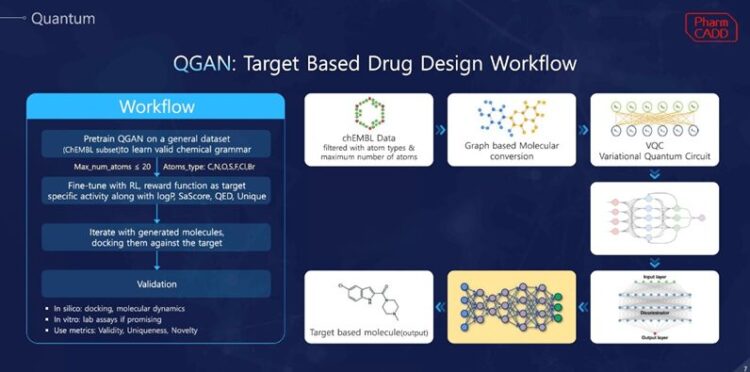
What impact did this new approach have? Dr.Wu’s presentation provided the answer.
First, 31,207 molecular structures were selected from the public drug database ChEMBL35 and used to train the QGAN, effectively teaching it the “chemical grammar” of drug-like molecules.
Next, PharmCADD applied both a conventional AI approach and a quantum-based approach to its long-studied FLT-3 (D835Y) mutation target. Ten candidates were generated using classical AI, and another ten using QGAN, forming a comparative experimental model.
Five drug-related indicators were evaluated and compared: molecular diversity, synthetic feasibility in real laboratories, binding affinity to the target protein (docking score), and two major toxicity risks of concern to pharmaceutical companies—cardiac toxicity (hERG) and liver toxicity (DILI).
“If Efficacy Is Similar, the Safer Candidate Wins”
In terms of efficacy and development difficulty, both approaches showed similar results. Docking scores were comparable, as was synthetic feasibility.
However, molecular diversity was approximately 7.9% higher in the QGAN-generated set, indicating a broader range of structurally distinct candidates.
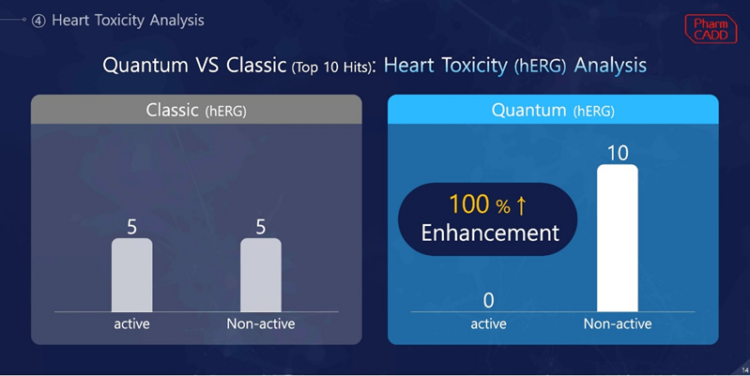
The most significant difference emerged in safety. Cardiac toxicity is commonly evaluated based on effects on the hERG channel; drugs that interfere with this channel can cause arrhythmia and sudden death and are therefore strictly screened out during development.
Dr.Wu explained, “In PharmCADD’s tests, five out of the ten candidates designed by conventional AI showed hERG toxicity signals. In contrast, all ten QGAN-designed candidates were predicted to be non-active.” In other words, none of the QGAN candidates showed suspected cardiac toxicity.
QGAN also outperformed in liver toxicity (DILI). While the conventional AI set included candidates classified in the highest-risk category (Most DILI), this worst category was completely absent in the QGAN set. Only lower-risk or safe candidates were generated.
Dr.Wu evaluated the results by stating that “cardiac toxicity was improved by 100%, and liver toxicity by approximately 42%.” He added that, based on PharmCADD’s internal in-silico toxicity evaluation criteria, “quantum advantage was clearly confirmed through this use case.”
From Molecular Synthesis to Cell-Based Assays: Demonstrating the PaaS Potential of Q-Pharmulator
In AI-based molecular design, a major bottleneck is whether a candidate can actually be synthesized. PharmCADD went one step further. Among the ten QGAN-generated candidates, five with relatively low synthetic difficulty were selected and commissioned for real chemical synthesis. All five were successfully synthesized at purities above 98%, with yields of 20~30 mg.
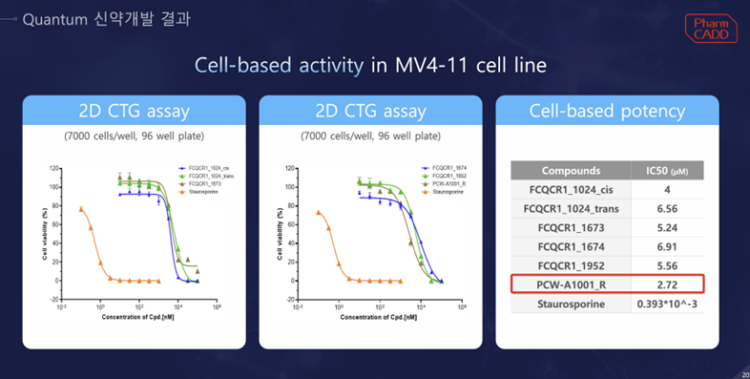
These compounds were then tested again for anticancer activity using the MV4-11 cell line. All five showed IC50 values in the single-digit micromolar (μM) range, demonstrating hit-level efficacy.
Following the first-generation AI-designed candidate PCW-A1001, PharmCADD thus advanced five second-generation “quantum + AI” designed candidates all the way through molecular synthesis and cell-based experiments. Preparations for patent filings on these candidates have also been completed.
Dr.Wu emphasized, “The choice of which group of drug candidates enters clinical development has a major impact on the probability of success.” Given the same cost and time constraints, a portfolio with similar efficacy but lower cardiac and liver toxicity risk is clearly advantageous.
Since 2023, PharmCADD has been participating in a National Research Foundation of Korea “Quantum Advantage Project” focused on atypical protein structure prediction, positioning the company as an early-moving startup in applying quantum computing to drug design.
Dr.Wu added, “PharmCADD plans to expand the application of quantum + AI combinations beyond small molecules to protein-based therapeutics such as peptides,” and noted that the company is also pursuing research to identify the most efficient “optimal recipe” of quantum algorithms and generative AI architectures.
What Will the Collaboration Between PharmCADD and NIBEC Deliver?
In particular, PharmCADD is conducting multiple collaborative projects with NIBEC Co., Ltd., a company recognized as a leader in peptide drug development within the Korean biotech ecosystem. By combining PharmCADD’s quantum + AI-based peptide drug design with NIBEC’s capabilities in peptide synthesis and cell and animal experiments, the partners expect to accelerate the creation of new drug candidates.
As generative AI and quantum computing rise simultaneously, the paradigm of drug design is rapidly evolving. If drugs with lower cardiac and liver risk can be effectively designed from the earliest stages, development of treatments for many intractable and rare diseases—still considered uncharted territory—will undoubtedly accelerate.
This is precisely why PharmCADD is further accelerating the development of its next-generation “Q-Pharmulator,” a hybrid platform that integrates quantum algorithms into its existing AI- and physics-based drug design system built on 260 CPU/GPU units.
[Key Terms Explained]- FLT-3 mutation: A mutation in a protein that causes acute myeloid leukemia
- IC50: The drug concentration required to inhibit 50% of cells (lower values indicate higher efficacy)
- hERG toxicity: Toxicity that interferes with cardiac ion channels and can cause arrhythmia
- DILI (Drug-Induced Liver Injury): Liver damage caused by drugs
- Qubit: The basic unit of quantum computing that can represent 0 and 1 simultaneously
- Docking score: A predicted score indicating how well a drug molecule binds to a target protein
- Hit: A candidate compound recognized as promising enough for further development in early drug discovery stages