


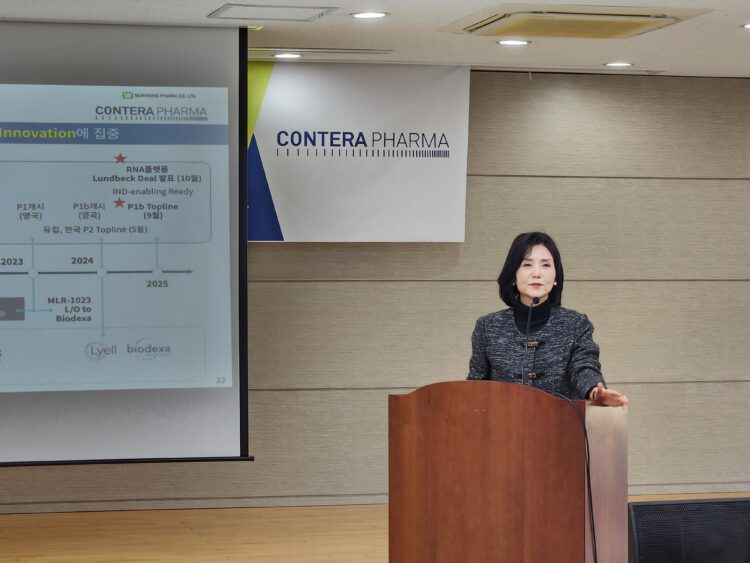
Bukwang Pharm announced on the 18th that its Danish subsidiary Contera Pharma will spin off its RNA therapeutics division to establish a new company. The decision reflects Chairwoman Ahn Mi-jeong’s commitment to “selection and concentration,” following her appointment as an inside director in March this year.
At a press briefing held at Bukwang Pharm’s Central Research Institute that day, Ahn stated, “We intend to grow Contera Pharma into a specialized RNA therapeutics company,” adding, “We will proceed with establishing the new entity as soon as possible.”
Ahn previously served as Chair of the Board at OCI Holdings and was appointed as an inside director of Bukwang Pharm in April. OCI Holdings is the largest shareholder of Bukwang Pharm, holding 17.11% of total shares. Ahn has conducted research in biochemistry and microbiology since 1985 and has served as a tribunal member at the Korean Intellectual Property Office, building expertise in pharmaceuticals and biotechnology. Over the past six to seven months since joining the board, she has discussed future growth directions with internal R&D personnel and set strategic priorities.
Ahn presented “selection and concentration” as the first agenda item in Bukwang Pharm’s growth strategy, with the Contera Pharma spin-off being the initial step. Contera Pharma is a Denmark-based CNS therapeutics biotech acquired by Bukwang Pharm in 2014.
Contera Pharma possesses RNA platform technology, and the company plans to split off the development division to establish a standalone RNA platform specialist. The RNA platform enables the analysis of disease-related genes, discovery of therapeutic targets, and development of treatments. Thanks to its unique technology, Contera signed an R&D collaboration agreement with the global Danish pharmaceutical company Lundbeck in October this year for RNA-based medicines. The new spin-off entity is expected to attract venture capital investment.
After the spin-off, the remaining Contera Pharma will continue its existing programs, including treatments for Parkinson’s disease patients. Its lead pipeline, CP-012, demonstrated safety and tolerability in a Phase 1b trial in September. Regarding this, Ahn said, “We plan to move into Phase 2 as quickly as possible,” but added, “We are still evaluating whether to proceed alone, pursue a joint study, or consider licensing-out.”
Parkinson’s disease patients often suffer from “early morning akinesia,” a condition in which their limbs stiffen upon waking. CP-012 is designed for delayed drug release, reducing morning akinesia symptoms. Taken the night before, the drug maintains its therapeutic effect until the next morning. Approximately 60–70% of Parkinson’s patients experience morning akinesia.
Bukwang Pharm also plans to connect domestic open innovation with global networks. Ahn explained, “Bukwang Pharm has been reviewing investments in Korean bio startups for the past one to two years, and many companies have submitted investment proposals. Since a few months ago, we have also been reviewing early-stage technology proposals from leading universities and research institutes in Korea.”
When investments proceed, Bukwang Pharm intends to participate as a strategic investor (SI) rather than a financial investor (FI), meaning the company aims to collaborate on growth strategies rather than simply provide capital. Ahn added, “Bukwang Pharm currently has no bio research institute, and we aim to internalize the research we have relied on overseas until now.” The company is also in discussions with venture capital firms to form a Bukwang-centered fund.
Ahn emphasized, “Our broader goal is to become a hub that connects domestic innovative technologies with global networks,” adding, “We will build an ecosystem where technologies and companies discovered in Korea can grow through the global network that Bukwang Pharm has accumulated.”