


A microneedle patch for obesity treatment, delivering drug absorption rates close to those of injections, has moved a step closer to commercialization.
Daewoong Pharmaceutical (Co-CEOs Park Seong-su and Lee Chang-jae) and Daewoong Therapeutics (CEO Kang Bok-gi) announced on the 13th that their microneedle patch containing semaglutide—an active ingredient for obesity treatment—demonstrated over 80% bioavailability compared with subcutaneous injection in early-stage drug absorption studies.
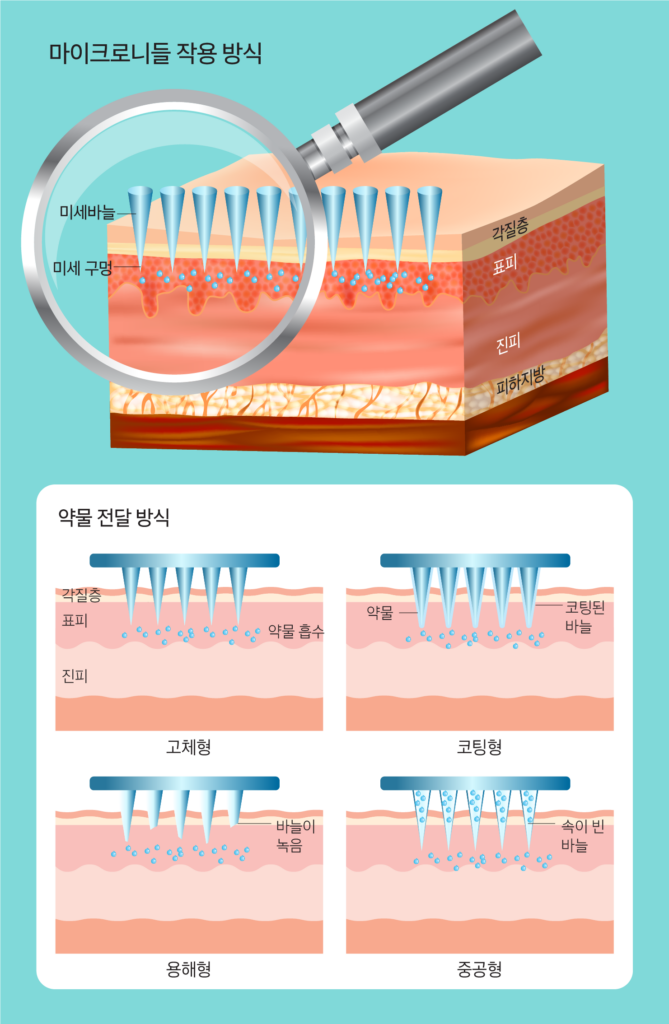
Microneedles are arrays of microscopic needles, each tens to hundreds of micrometers in size, that deliver drugs or vaccines through the skin. Depending on formulation and delivery mechanism, they can be: (1) solid-type, which create microchannels in the skin for drug diffusion; (2) coated-type, where the drug is coated onto the needle surface; (3) dissolving-type, where the needles dissolve inside the skin to release the drug; and (4) hollow-type, which directly inject liquid drugs. Because microneedles bypass the gastrointestinal tract and liver metabolism, drug loss is minimized and bioavailability is higher. Patch delivery also greatly reduces pain compared with injections, improving patient compliance.
The study involved 70 healthy adults. Researchers applied Daewoong Therapeutics’ proprietary ‘CLOPAM’ microneedle patch and measured blood drug concentrations, then compared the results with those from subcutaneous semaglutide injections under the same conditions.
Analysis showed the microneedle patch achieved more than 80% bioavailability compared to injection. Assuming the bioavailability of subcutaneous injection is 100%, the patch delivered over 80% of the drug effectively into the body—representing the highest concentration level for microneedle patches to date and approximately 160 times higher than that of oral semaglutide. Blood concentrations also remained stable for a week, supporting the potential for a once-weekly dosing regimen.
For GLP-1 (glucagon-like peptide-1) drugs—currently in the spotlight for obesity treatment—the key differentiator is not the active ingredient but the delivery method. While subcutaneous injections have high bioavailability, they can cause pain or injection-related anxiety. Recently developed oral formulations have lower absorption and require fasting, with restrictions on water intake, making them less convenient. In contrast, microneedle patches can be applied just once a week and could be suitable for a wide patient population, including children, adolescents, and the elderly.
Daewoong Therapeutics’ CLOPAM platform is considered a next-generation manufacturing technology optimized for dissolving-type microneedle patches. It uses “pressurized drying” and “airtight sealing” techniques to enhance drug uniformity and stability, enabling precise administration without contamination risk. Unlike products requiring refrigeration, CLOPAM-based patches remain stable at room temperature, lowering distribution costs. The platform is currently covered by 52 domestic and international patent applications.
Based on these results, Daewoong Therapeutics is exploring multiple collaboration models with global partners, including technology licensing, co-development, and out-licensing, as part of its push toward global market entry and commercialization.
“This study demonstrated that a single patch loaded with a high dose of semaglutide can achieve drug delivery efficiency suitable for once-weekly administration,” said Kang Bok-gi, CEO of Daewoong Therapeutics. “It represents a meaningful step forward in overcoming the limitations of existing microneedle patch technology for obesity treatment, and marks an important milestone for global licensing and commercialization.”
Park Seong-su, CEO of Daewoong Pharmaceutical, added, “This is the first case of breaking through the technical barrier for high-dose drug delivery. We plan to expand microneedle applications to various biologics and lead the global platform market.”