


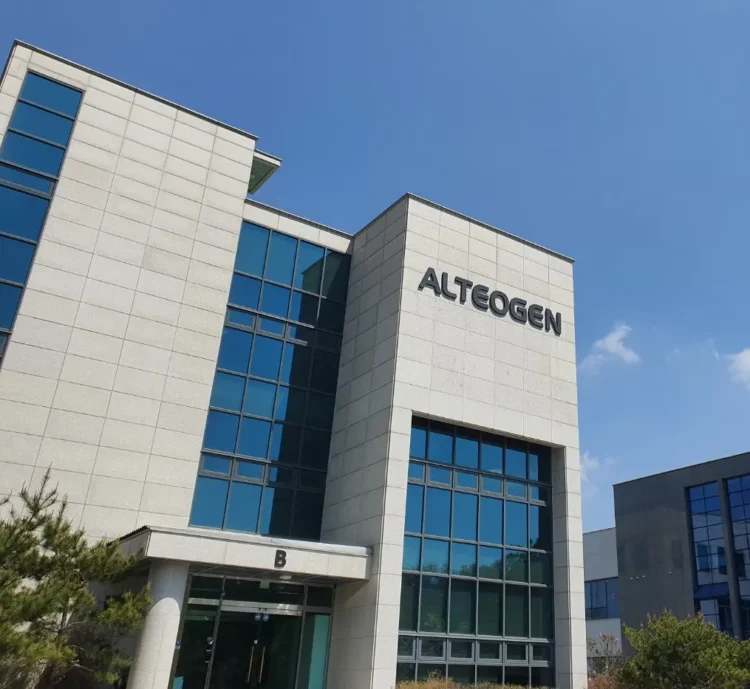
Alteogen, the No. 1 company on KOSDAQ by market capitalization, is set to move to Korea’s main bourse, the KOSPI market. This marks the second major biotech transfer listing following Celltrion. As the company’s share price recently plunged after a German court issued a provisional injunction to halt sales of Keytruda SC (subcutaneous formulation), attention is focusing on whether the matter will affect the preliminary listing review.
On Dec. 8, Alteogen held an extraordinary shareholders’ meeting at the Daejeon Convention Center and approved the agenda item titled “Delisting from KOSDAQ (conditional) and Transfer Listing to KOSPI.” With this vote, discussions on a KOSPI transfer—initiated earlier this year—have formally begun.
Earlier this year, the company’s second-largest shareholder, Hyeong In-woo, CEO of Smart & Growth, stated that he had “continuously requested CEO Park Soon-jae to move Alteogen to the KOSPI market after the firm became the top-valued company on KOSDAQ,” effectively triggering the renewed push toward the transfer.
In KOSPI transfer reviews, the Korea Exchange evaluates not only quantitative criteria such as revenue and equity capital but also qualitative factors, including business soundness and management transparency. Companies with a market capitalization exceeding KRW 1 trillion (approx. USD 750 million) are considered to have met the quantitative threshold; therefore, for Alteogen—whose market cap fluctuates around KRW 25 trillion (approx. USD 18.7 billion)—the focus now shifts to the qualitative assessment.
According to the Korea Exchange’s listing review guidelines, companies involved in litigation or disputes over patents must demonstrate that such issues will not significantly affect business operations to pass the preliminary review.
Complicating matters, a German court recently granted Merck & Co. (MSD) a provisional injunction banning the sale and distribution of Keytruda SC in Germany, sending shockwaves through the market. Merck commercialized Keytruda SC using Alteogen’s hyaluronidase-based subcutaneous formulation platform technology.
Industry observers, however, generally expect the impact on Alteogen to be limited. The company also dismissed concerns through a shareholder announcement titled “Notice on the German Court’s Injunction Regarding Keytruda SC,” emphasizing that Germany’s patent litigation system commonly issues such injunctions at an early procedural stage. Because separate courts rule on patent infringement and patent validity, a preliminary injunction can be issued within hours without hearing the counterparty’s position.
The securities industry also shares this view. Hana Securities researcher Kim Seon-ah commented, “The injunction in Germany will have only a very minor impact on overall sales.” She added that the German ruling is independent of the determination on patent validity, applies only within Germany, does not affect U.S. sales, and that other countries in Europe and beyond will make independent decisions regarding any injunctions.
Alteogen will now proceed to file for preliminary listing review with the Korea Exchange for its KOSPI transfer. Once approved, the company must submit a securities registration statement to the Financial Supervisory Service, delist from KOSDAQ, undergo a temporary trading halt, and subsequently complete its transfer to the KOSPI market.
Meanwhile, concerns remain regarding potential volatility-related losses for minority shareholders during the transfer process. When Celltrion resolved to transfer to KOSPI in September 2017, its stock traded around KRW 142,000 (approx. USD 106). But by early the following year—three months later—the share price had soared past KRW 350,000 (approx. USD 262), more than doubling. Ahead of the Feb. 9 transfer, volatility intensified when Nomura Securities, a Japanese firm, published a report in mid-January assigning a target price of KRW 230,000 (approx. USD 172), triggering a roughly 10% drop in the stock.