


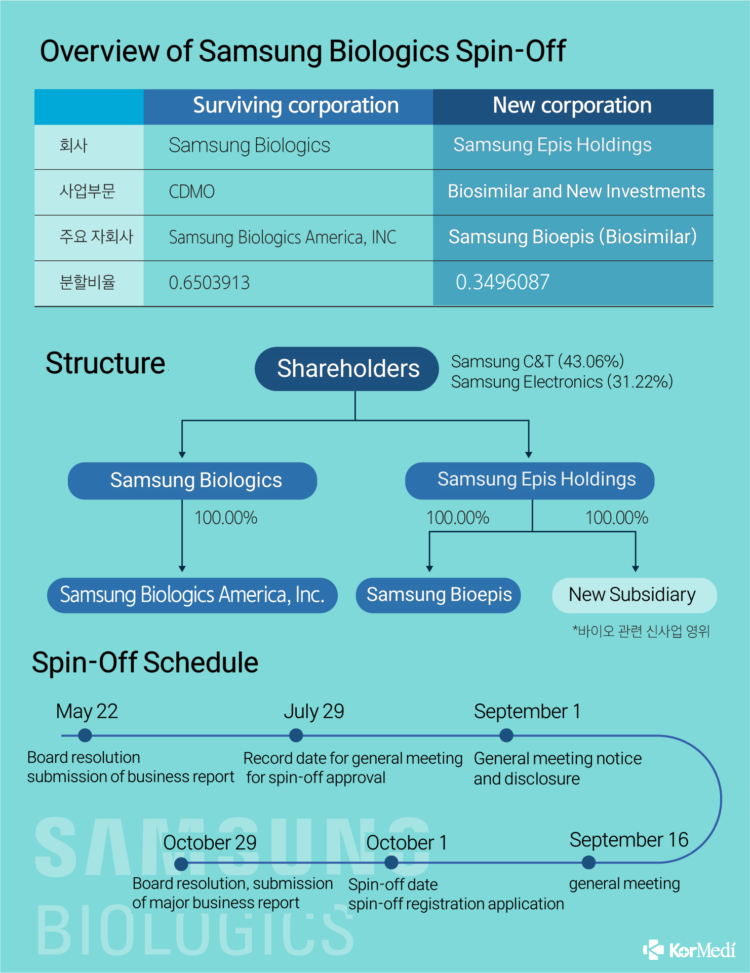
Samsung Group’s biopharmaceutical business is being reorganized into two separate tracks: CDMO (Contract Development and Manufacturing Organization) and biosimilars. Samsung Biologics plans to conduct a vertical spin-off, separating its subsidiary management and new investment functions to establish a new entity, tentatively named Samsung Epis Holdings. Samsung Biologics will become a pure-play CDMO, while the new holding company will oversee Samsung Bioepis and focus on biosimilar operations.
Samsung Biologics announced the plan following a board resolution on May 22. The effective date of the spin-off is October 1. Existing shareholders will receive shares in Samsung Biologics and Samsung Epis Holdings in a ratio of 0.6503913 to 0.3496087. On October 29, Samsung Biologics will undergo a revised listing, and the newly created Samsung Epis Holdings will also be listed.
The move is aimed at eliminating competitive overlap between Samsung Biologics, which provides CDMO services, and Samsung Bioepis, which develops and markets biosimilars.
“Because Samsung Biologics and Samsung Bioepis were tied together as parent and subsidiary, many clients perceived them as a single entity, raising concerns about potential competitive overlap,” said Yoo Seung-ho, Executive Vice President of Samsung Biologics, during an online briefing. “We decided on the spin-off to address these concerns and prevent any perception that we are competing with our CDMO clients.”
He added, “CDMO and biosimilar businesses differ in nature, structure, and risk profile, which has made investment decisions more complex. The spin-off will allow investors to selectively invest in the business that aligns with their interests.”
The decision was also influenced by external and internal factors, including trade policy uncertainty. Yoo said, “The recent shift in U.S. tariff policy, intensifying competition for contracts, and broader market uncertainty made this the right time to resolve the issue.”
After the spin-off, Samsung Biologics will focus solely on its CDMO business, including large-scale biologics manufacturing and expansion into high-growth platforms such as bispecific antibodies, antibody-drug conjugates (ADCs), and cell and gene therapies. The company plans to build eight plants by 2032, targeting a total capacity of 1.324 million liters, with the goal of becoming the world’s top CDMO.
Samsung Epis Holdings will manage Samsung Bioepis as a key subsidiary. Over the mid-to-long term, it plans to pursue investments in new technologies, establish new subsidiaries, and build bioplatform capabilities. Samsung Bioepis aims to launch more than 20 products globally, and accelerate the development of next-generation biosimilars based on bispecific antibodies, ADCs, and PD-1 checkpoint inhibitors.
Samsung emphasized that the spin-off is not related to group-level governance restructuring. As of the first quarter, Samsung C&T holds a 43.06% stake in Samsung Biologics, followed by Samsung Electronics with 31.22%.
Samsung also made clear that it has no plans to list Samsung Bioepis within the next five years, in order to avoid confusion over potential dual listings.
“An IPO for Samsung Bioepis has drawn investor interest,” said Kim Hyung-jun, Executive Vice President of Samsung Bioepis. “But for now, our focus is on stabilizing the business as a core subsidiary of the new holding company. Discussing a listing at this point could confuse investors, so it is not under consideration.”