


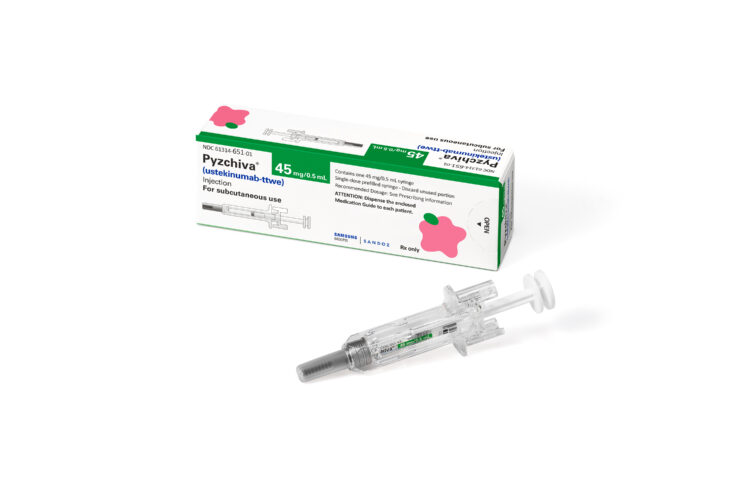
Samsung Bioepis has cleared a key legal hurdle in the U.S. market for its autoimmune disease biosimilar Pyzchiva, following a court ruling that dismissed an injunction request by Johnson & Johnson (J&J).
According to Bloomberg Law and other international media outlets, the U.S. District Court for the District of New Jersey denied J&J's motion for a preliminary injunction on April 28 (local time), effectively allowing Samsung Bioepis and its partner Sandoz to continue marketing Pyzchiva in the United States.
Pyzchiva is a biosimilar referencing Stelara, J&J’s blockbuster treatment for autoimmune diseases such as plaque psoriasis, psoriatic arthritis, Crohn’s disease, and ulcerative colitis. The global sales of Stelara reached approximately $10.36 billion in 2023, with the U.S. market alone accounting for about $6.72 billion.
Samsung Bioepis had launched Pyzchiva in the U.S. through Sandoz on February 22, 2025, under a licensing agreement signed with J&J’s subsidiary Janssen in 2023. However, within just two days of launch, J&J filed for an injunction, citing a breach of contract.
The core issue was the use of a private label (PL) distribution model. Sandoz had signed a deal with a major pharmacy benefit manager (PBM) to distribute Pyzchiva under a different brand name, which J&J argued violated the terms of their agreement—claiming that while Samsung Bioepis had the right to sell Pyzchiva, it did not have the right to authorize third-party branding.
Private labeling allows the same product to be marketed under different names, potentially enabling broader market penetration. The court, however, rejected J&J's interpretation and ruled against the injunction. Further details of the decision were not disclosed due to confidentiality agreements.
The ruling now permits Samsung Bioepis to market Pyzchiva through PL channels, which could significantly enhance its market reach. Partnering with large PBMs, which have extensive distribution networks, also increases the potential for high-volume prescriptions.
This strategy has already proven successful. CVS Health, one of the top three PBMs in the U.S., markets Sandoz’s adalimumab biosimilar Hyrimoz through its subsidiary Cordavis. Hyrimoz has since captured approximately 15% of the U.S. adalimumab market.
With the legal obstacle now removed, Samsung Bioepis is expected to accelerate its U.S. marketing efforts for Pyzchiva, aiming to capture a share of the highly lucrative Stelara biosimilar market.