


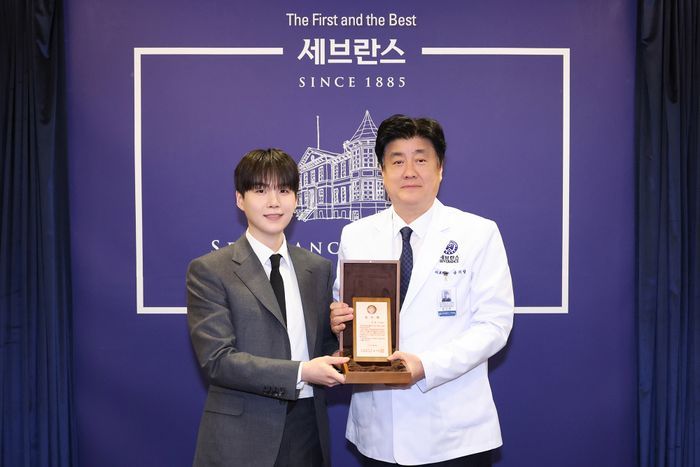
The “Min Yoon-gi Therapy Center” at Severance Hospital in Seoul officially opened on Monday, funded by a ₩5 billion ($3.6 million) donation from BTS member Suga (whose real name is Min Yoon-gi). The center specializes in treating children and adolescents with autism spectrum disorder (ASD) through art-based therapies.
Far more than a conventional medical facility, the Min Yoon-gi Therapy Center serves as a symbolic space, demonstrating how the positive influence of a global artist can be translated into social impact. The opening ceremony was attended by Yonsei University President Dong-sup Yoon, Yonsei University Health System CEO Ki-chang Keum, and Yong-jik Kim, President of the Korea Autism Society. The center will be led by Keun-ah Cheon, professor of child psychiatry at Yonsei University.
In June, Suga contributed the largest-ever celebrity donation in the hospital’s history—₩5 billion—with the intention of helping children with autism “grow up healthy as members of society.”
His personal commitment is embedded throughout the center’s design and programs. Its flagship initiative, called MIND, is a music-based social skills program developed in collaboration between Suga and Professor Cheon. Despite a demanding schedule, Suga spent much of last year and early this year volunteering with autistic children, using music to engage directly with them and seeking new ways to connect at their level.
The center has been designed as a safe space where children can learn to communicate with the world. Alongside language and behavioral therapy rooms, it features music therapy facilities equipped with professional-level soundproofing, as well as spaces for group social skills training. In the waiting area, works by artist Kyu-jae Lee—who himself is on the autism spectrum—will be displayed.
A multidisciplinary team of child psychiatrists, music, speech, and behavioral therapists, and clinical psychologists will provide personalized, integrated care. While initial efforts will focus on music, the program aims to expand into other artistic fields such as visual arts and physical activity, with plans to foster specialist training and conduct clinical research to advance autism treatment in Korea.
“Here at the Min Yoon-gi Therapy Center, we not only teach children music to enhance therapeutic outcomes, but also help them build social skills,” said Professor Cheon. “As the public sees autistic children striving for independence, we expect to see significant progress in improving perceptions of disability.”