

Celltrion, which has entered the rapidly emerging field of antibody–drug conjugates (ADCs), is seeking to differentiate itself with a “biobetter ADC” that improves or overcomes the shortcomings of existing antibody drugs.
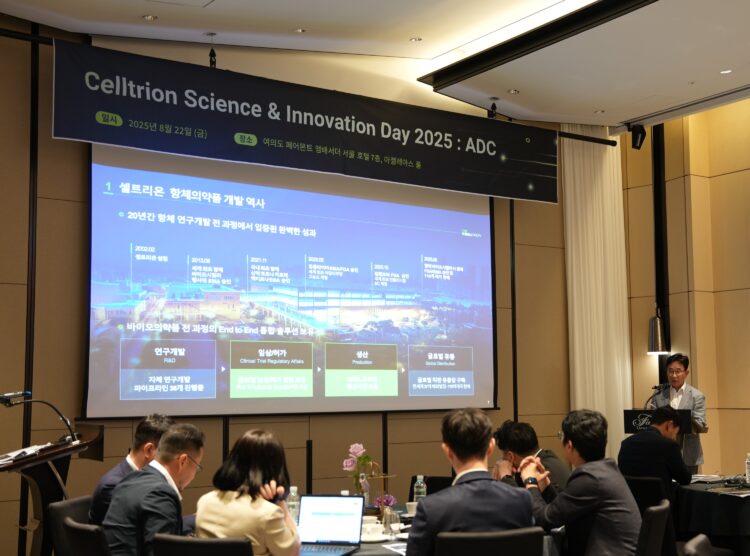
The company recently hosted its first “Science & Innovation Day 2025,” where it unveiled its ADC pipeline and long-term vision to analysts. Partner companies also joined to share updates on co-development projects and technologies.
In recent years, ADCs have become one of the most closely watched areas in oncology. These therapies use antibodies to recognize and bind to cancer cells, delivering a cytotoxic payload directly to tumors. While many early efforts failed due to toxicity, the commercial success of “Enhertu” has triggered a surge of development by global pharmaceutical companies. According to U.S. market research firm Grand View Research, the ADC market is projected to more than double from USD 11.29 billion (KRW 15.58 trillion) in 2023 to USD 24.01 billion (KRW 33 trillion) by 2030. Yet fewer than 20 ADCs have been approved to date.
Against this backdrop, Celltrion is betting on a biobetter. A biobetter goes beyond a biosimilar by improving efficacy, safety, or convenience compared to the original biologic. In small-molecule terms, it is similar to an “incrementally modified drug” or “line extension.” Because biobetters are protected by new patents, they can enter the market before the originator’s patent expires.
Celltrion already has experience transforming its flagship infliximab biosimilar “Remsima” from an intravenous (IV) formulation into a subcutaneous (SC) version, which received FDA approval as a new drug in the U.S. By going beyond simple replication, the company expanded global market access by improving patient convenience. Its ADC strategy is seen as an extension of this approach: combining existing antibodies with novel payloads to overcome limitations, while leveraging its deep expertise in antibody development and manufacturing from its biosimilar business to reduce risks and uncertainties.
The most advanced candidate in Celltrion’s pipeline, CT-P70, is a biobetter ADC designed to overcome the limitations of AbbVie’s non-small cell lung cancer therapy “Teliso-V” (generic name: telisotuzumab vedotin). CT-P70 uses the same c-MET-targeting antibody and linker as Enhertu, but incorporates PhinoBio’s novel payload “PBX-7016,” which is expected to reduce adverse events. The program began first-in-human dosing in Korea last month and aims to expand indications to other cancers, including lung cancer.
The second candidate, CT-P71, is being developed for patients resistant to “Padcev” (enfortumab vedotin), an ADC from Astellas that targets Nectin-4. Padcev uses the microtubule inhibitor MMAE as its payload. Celltrion plans to replace this with PBX-7016, aiming to demonstrate efficacy even in resistant populations. A Phase 1 trial is expected to begin this year.
CT-P73 targets tissue factor (TF), which is overexpressed in cervical and head-and-neck cancers. Like the other candidates, it employs PBX-7016. Celltrion presented preclinical data on CT-P73 at the World ADC Asia Summit in June. Currently, the only marketed TF-targeting ADC is Pfizer’s cervical cancer drug “Tivdak” (tisotumab vedotin).
Celltrion plans to submit IND (Investigational New Drug) applications for three ADC candidates this year and advance a total of 13 new drug programs into clinical trials by 2028. Longer-term goals include the development of bispecific ADCs and other globally innovative first-in-class medicines.
The company’s strong funding base and partnerships are also considered advantages. While many biotech firms rely heavily on external financing, Celltrion can invest in R&D using the substantial revenues generated from its biosimilar business. It is also accelerating development through collaborations with PhinoBio and WuXi XDC.
Seo Jin-seok, CEO of Celltrion, said: “By building on Celltrion’s long-standing expertise in antibodies and accelerating progress through active partnerships, we aim to speed up the development of innovative medicines. We are committed to rapidly bringing new therapies to market that can provide better treatment options in oncology—where unmet needs remain high—as well as in other therapeutic areas.”
Analysts at the event responded positively. Ye No-rae, an analyst at Hyundai Motor Securities, wrote in a report: “From the second half of next year, we expect continuous clinical data releases. Based on early Phase 1 results from CT-P70, the safety and efficacy of PBX-7016 can be validated, paving the way for aggressive expansion into additional indications.”
Ye added: “The key point is that Celltrion’s budget plan can be met within its own R&D spending without additional fundraising. This financial stability is closely tied to development speed. While the company entered the ADC race later than global peers, it is now accelerating rapidly.”
Jung Hae-joo, an analyst at Korea Investment & Securities, said: “The paradigm in ADC development is shifting. In the early days, linker technology was seen as the key to success, but now with diverse linker–antibody–payload combinations and growing clinical datasets, execution and scalability matter more than simple technology ownership. Going forward, the success of ADC development will hinge on execution, speed, financial capacity, and insight.”
Jung Yi-soo, an analyst at IBK Investment & Securities, added: “Celltrion’s biobetter ADC strategy appears to be an effective way to leverage its biosimilar experience and move into new drug development.”