


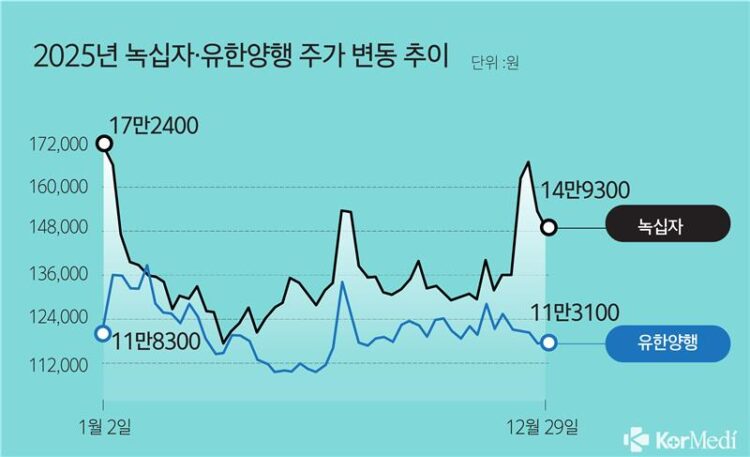
Share prices of pharmaceutical and biotech companies rose sharply this year, driven largely by biotech firms leveraging platform technologies to secure major licensing deals with global pharmaceutical companies. In contrast, some large-cap pharmaceutical companies, including Yuhan Corp. and GC Pharma, have seen their share prices decline despite expectations of improved earnings.
According to the Korea Exchange on the 29th, the KRX Healthcare Index rose 1,162.9 points, or 31.5%, from 3,695.09 at the beginning of the year to 4,857.99 as of that day. This indicates that share prices across the pharmaceutical and biotech sector generally trended upward throughout the year. The KRX Healthcare Index is composed of large-cap healthcare stocks listed on the KOSPI and KOSDAQ, and currently includes 67 companies such as Samsung Biologics, Celltrion, Yuhan Corp., Hanmi Pharmaceutical, Alteogen, and Ligachem Biosciences.
The key drivers behind the index’s rise were biotech companies built around platform technologies. A representative example is ABL Bio Inc., which holds a blood–brain barrier (BBB) shuttle platform. Its share price rose 6.6-fold from KRW 29,750 at the start of the year to KRW 199,000 at the close on the day. During the same period, Alteogen Inc., which owns a subcutaneous (SC) formulation platform technology, saw its share price rise from KRW 300,000 to KRW 455,000—an increase of KRW 155,000, or 51.7%.
Lee Tae-gyu, Chief Executive Officer of Scaleup Partners, said, “Innovative platforms developed by biotech companies and large-scale licensing deals with global pharmaceutical companies have been reflected in share prices,” adding, “Companies that have successfully completed platform technologies are being highly valued by the market.”
Indeed, ABL Bio signed licensing agreements worth USD 3.02 billion (approximately KRW 4.32 trillion) with GlaxoSmithKline (GSK) and USD 2.562 billion (approximately KRW 3.67 trillion) with Eli Lilly, while Alteogen entered into a deal worth USD 1.35 billion (approximately KRW 1.93 trillion) with AstraZeneca.
Despite the overall strength of the pharmaceutical and biotech index, some large pharmaceutical companies have moved against the broader market trend. A prime example is Yuhan Corp., the country’s largest pharmaceutical company by revenue. Its share price stood at KRW 118,300 at the start of the year but ended the session at KRW 113,100 after trading sideways throughout the year, down 4.4% from the beginning of the year.
While the securities industry expects Yuhan Corp.’s earnings to improve, its share price has remained stagnant. SK Securities forecast that Yuhan Corp. will post revenue of KRW 2.2318 trillion (approximately USD 1.65 billion) and operating profit of KRW 138.6 billion (approximately USD 102 million) this year. Compared with last year’s figures—revenue of KRW 2.0678 trillion and operating profit of KRW 54.9 billion—this represents a 7.9% increase in revenue and a 152.5% jump in operating profit. SK Securities also raised its target price from KRW 140,000 to KRW 160,000. Nevertheless, performance and share price have moved in opposite directions.
GC Pharma’s situation is even weaker. Its share price fell 13.4% from KRW 172,400 at the start of the year to KRW 149,300 as of that day. GC Pharma posted revenue of KRW 1.68 trillion and operating profit of KRW 32.0 billion last year. Hyundai Motor Securities expects the company to generate revenue of KRW 1.936 trillion and operating profit of KRW 63.0 billion this year, representing increases of 15.2% and 96.9%, respectively. The brokerage has set a target price of KRW 210,000. Despite this, the stock has failed to gain momentum, which analysts attribute to earlier expectations already being priced in.
As pharmaceutical and biotech stocks soar, the contrasting declines in Yuhan Corp. and GC Pharma have weighed on retail investors. One investor wrote on an online stock discussion board, “Almost everything has gone up except Yuhan Corp. and Celltrion,” adding, “I may regret choosing Yuhan Corp., but there is still some hope, so let’s hang in there a little longer,” in an attempt to reassure fellow shareholders.
Among traditional large-cap pharmaceutical companies, Daewoong Pharmaceutical and Hanmi Pharmaceutical have seen their share prices rise more than 30% since the start of the year. Closing prices on the day stood at KRW 175,100 for Daewoong Pharmaceutical and KRW 451,000 for Hanmi Pharmaceutical, up KRW 48,300 (38.1%) and KRW 172,500 (61.9%), respectively, from the beginning of the year. Lee explained, “Daewoong Pharmaceutical has been delivering results through active acquisitions of innovative platforms, while Hanmi Pharmaceutical appears to have recovered after governance issues earlier this year were resolved.”